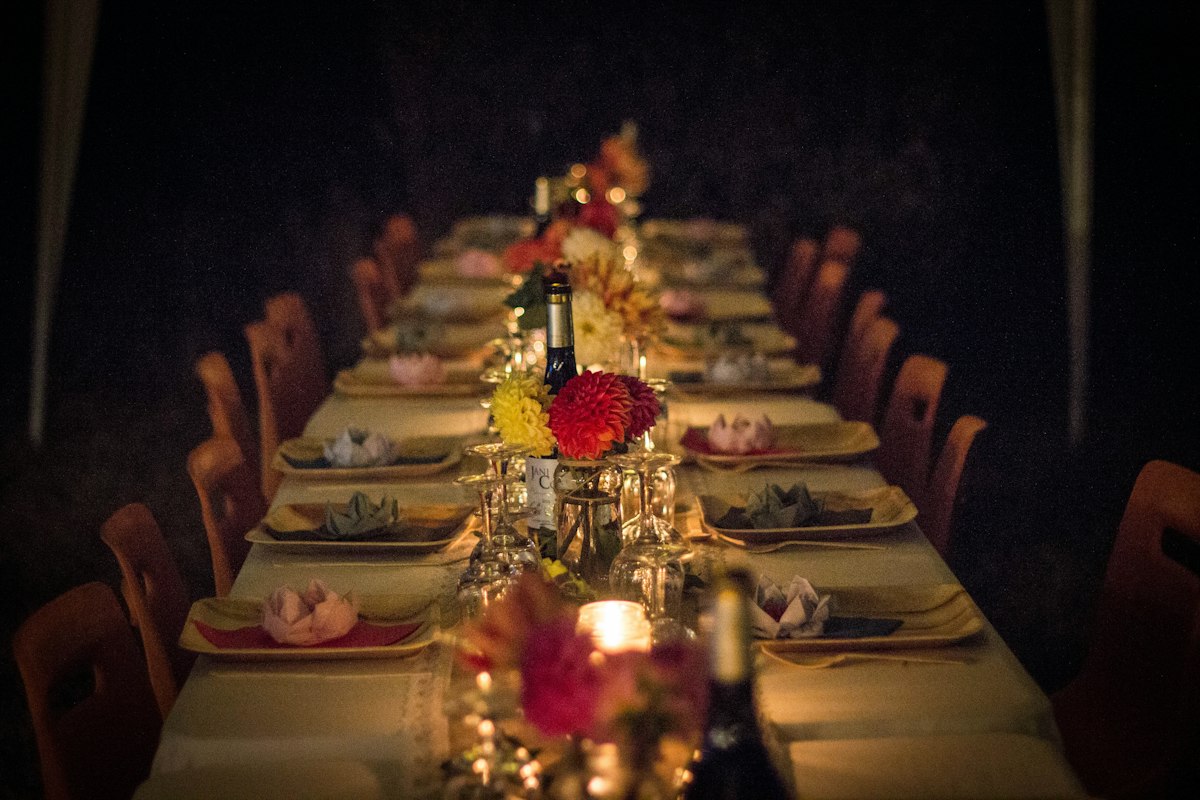
A member buying wine for a dinner they are hosting is a transaction your system records as one person, though eight drank it. Give the hosted occasion a shape, a table-sized quantity, a delivery window tied to the date, a card that travels with the wine, and an occasion field, and it becomes a commerce lane you can see.
Somewhere on your list this month, a member is buying six bottles for a dinner they are hosting. Eight people will drink your wine that evening, most of whom have never bought from you, several of whom will ask what it was. Your commerce platform records that evening as one transaction, one member, one shipping address. Every other place in your business where a group of strangers tastes your wine has instrumentation around it: the tasting room has a reservation system, an event has an RSVP list, a trade pour has a rep and a report. This one has nothing, and it happens more often than all of them.
It is worth saying clearly what this is not, because the category it gets filed under is the reason nobody has built anything around it. It is not a referral program.
The Shared Table
The Shared Table treats the member-hosted occasion as a commerce lane with its own shape rather than as an ordinary reorder that happens to be larger. Nobody is recruited, no introduction is requested, and no member is asked to spend social capital on your behalf. Three components.
Component 1: Name the occasion, not the referral
The framing decision comes first and determines whether the rest works.
A referral ask puts the member in the position of vouching, which costs them something real and which your best members ration carefully. That is precisely why referral volume plateaus in programs with excellent retention: the pool of people willing to make introductions is finite and gets used.
A hosted occasion asks nothing of the relationship. The member is having people over. They were going to serve wine. The only question in front of them is whose, and how much, and whether it arrives in time. You are competing with a supermarket run on a Thursday, not asking for access to anybody’s address book. Hold that distinction in the copy as strictly as you hold it in your own thinking, because the moment the offer smells like recruitment, it collects the same resistance the referral ask collects.
Component 2: Give it a transaction shape
Right now this purchase has no shape, so it defaults to the shape of a normal order and performs like one.
Three elements give it a shape. A quantity built for a table rather than for a person: six bottles across two wines is a dinner, twelve is a party, and a member planning either should not have to assemble it bottle by bottle from a list designed for personal consumption. A delivery window tied to the date rather than to your fulfillment calendar, since arriving two days after the dinner is a complete failure of an otherwise perfect order. And something that travels with the wine to the table: a card with the wines named and one line about each, in your voice, that the host can read out or leave on the sideboard.
None of that is a discount, and the discount instinct is the thing to resist. A member hosting a dinner is not price-sensitive on the day; they are logistics-sensitive and pride-sensitive. Solve those two and the order grows on its own.
The other thing a shape does is make the purchase askable. Right now there is no moment in your calendar where it would be natural to raise this, because an unnamed thing cannot be offered. Once it has a name and a shape, it has obvious placements: the release email in the weeks before the holidays, the confirmation after a visit where somebody mentioned an anniversary, the note to a member whose last three orders were all larger than their allocation. None of those is a campaign. They are places where a sentence about a dinner now fits and previously did not.
Component 3: Record the second party as a party
This is the component with the longest tail, and it is a data decision rather than a marketing one.
Look at where records actually come from in this category. Point of sale accounts for 55.2% of DTC transaction volume, and 47% of all new customer records are created there (Commerce7 Data Drop, “The Tasting Room Effect”). Records follow transactions. The hosted dinner is a transaction that creates none, because the system has one field for a person and the evening had nine.
The fix is modest and entirely within your control. Add an occasion field to the order: what it was for, and roughly how many people. That alone changes what you can ask of the data later. Then give the host an easy, optional way to bring the table into contact with you on their terms, which almost always means something the guests take rather than something you take from the guests: a card with a link to the wines they drank, a small allocation held for that address for a fortnight, an invitation the host can pass on. You are not collecting the room. You are making it possible for the room to find you.
What This Produces
The first output is visibility, and it arrives immediately, because the occasion field tells you within a quarter how much of your volume is already going to other people’s tables. Most Directors are surprised by the number, and it’s one nobody at your winery has ever had.
The second is basket size, and the mechanism is the same one behind the clearest verified finding in this part of our business: members who can edit their packages show 20.7% higher average order value and roughly 50% lower churn, across 1.4 million memberships at 17,000 programs (Commerce7 Data Drop, June 2026). That is an association rather than an experiment, and the lever underneath it is agency. A hosted occasion is agency with a date attached, which is why it behaves like the strongest version of it.
The third is slower and is the reason this belongs in a growth conversation rather than a service one. Annual retention in this category runs roughly 64% to 77%, with about 40% of members cancelling inside their first year (Silicon Valley Bank, State of the US Wine Industry 2026). A member who has served your wine to their own guests, by name, at their own table, has made a public statement about your winery in front of people whose opinion they care about. That is a different relationship from one that consists of four deliveries a year, and it does not require them to introduce anybody to you.
The Objection You Will Hear Internally
Somebody will say this is a referral program with the serial numbers filed off, and that you are dressing up an ask.
The test is whether the member has to do anything relational for you to get paid. In a referral program they do; the introduction is the product. Here the transaction completes whether or not a single guest ever contacts you, and everything downstream is optional and host-controlled. If your implementation drifts so that the member is chasing guest details on your behalf, you have rebuilt the referral program and you will get referral-program fatigue.
A second objection will come from operations, and it is fair: date-certain delivery is harder than it sounds, and a missed dinner is worse than no program. Start with the window you can actually hold, in the states you ship to most, and say no to dates you cannot make. One late arrival at a member’s own dinner party will cost you more than a quarter of this will earn.
This Month’s Action
Pull last quarter’s orders and flag every one that was larger than that member’s normal order and shipped to their own address. That rough filter catches most hosted occasions, and the count is your baseline.
Then call three of those members and ask what the order was for. Not a survey; three calls. You will learn what shape the offer needs, and you will hear the occasion described in the member’s own words, which is where the copy for it should come from.
P.S. The three ideas from this week share a shape. Each one takes something your members are already doing, choosing, writing, or pouring for other people, and gives it a record. Friday’s email puts them together and shows what a program looks like when all three are running.